
Cognitive load in the English classroom: are we overloading our students?
In many English classrooms, active lessons are often equated with effective lessons. More activities, more worksheets, more tasks, more instructions. The assumption is simple: the more students do, the more they learn.
However, research in cognitive science suggests otherwise.
Cognitive Load Theory (Sweller, 1988) reminds us that learning depends heavily on the limits of working memory. When those limits are exceeded, learning does not increase. It decreases.
The key question for English teachers is not whether students are working hard. It is whether their cognitive resources are being used efficiently.
What is cognitive load? 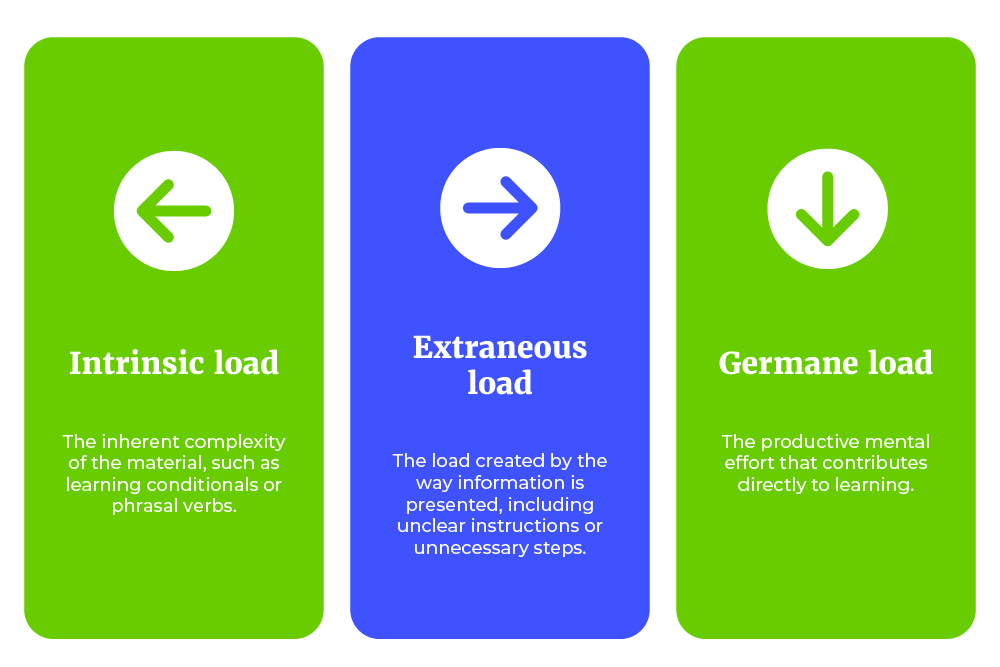
Cognitive Load Theory explains how the brain processes new information. Working memory, the system responsible for temporarily holding and manipulating information, has a limited capacity. It can only handle a small number of elements at a time.
When instructional design overwhelms working memory, students struggle to process, retain, and transfer information into long-term memory.
Sweller distinguishes between three types of cognitive load:
- Intrinsic load. The inherent complexity of the material, such as learning conditionals or phrasal verbs.
- Extraneous load. The load created by the way information is presented, including unclear instructions or unnecessary steps.
- Germane load. The productive mental effort that contributes directly to learning.
In language classrooms, intrinsic load is often unavoidable. Extraneous load is not.
What cognitive overload looks like in ELT
Cognitive overload does not always appear as disengagement. Sometimes it looks like:
- Students asking for instructions to be repeated
- Incomplete tasks despite effort
- Silence during speaking activities
- Frequent reliance on L1
- Surface-level answers instead of deeper processing
Consider a common scenario. Students receive a reading text, a vocabulary list, comprehension questions, a grammar focus, and a follow-up speaking task within the same lesson. Each component may be valuable, but together they may exceed working memory capacity.
The result is that students move through activities without fully consolidating learning.
Busy does not always mean effective.
Why language learning is especially vulnerable
Language learning places unique demands on working memory. Students must simultaneously decode vocabulary, process grammar, monitor pronunciation, plan meaning, follow instructions, and manage social interaction.
In speaking tasks, learners often juggle linguistic accuracy and communicative intent at the same time. When task design adds unnecessary complexity, cognitive overload becomes more likely.
This is particularly relevant in multilingual classrooms or at lower proficiency levels, where intrinsic load is already high.
Reducing extraneous load: practical strategies
The goal is not to remove challenge. It is to remove unnecessary mental strain so students can focus on meaningful processing.
Here are research-informed adjustments teachers can implement.
Simplify instructions
Break instructions into clear steps. Model before asking students to perform. Avoid giving all instructions at once.
Clarity reduces extraneous load.
Sequence tasks intentionally
Avoid stacking cognitively demanding tasks back-to-back.
Instead of introducing multiple new elements in one lesson, distribute them strategically. Pre-teach key vocabulary before reading. Allow guided discussion before independent speaking. Consolidate grammar after comprehension has been secured.
Spacing cognitive demand supports retention.
Reduce split attention
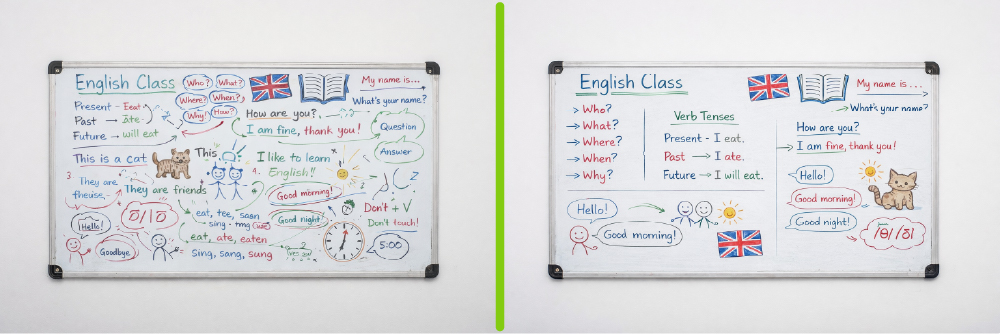
When students must constantly shift between textbook, board, worksheet, and slides, working memory is taxed.
Whenever possible, integrate information in one place. Keep visual layout clean. Avoid overcrowded slides.
Build in retrieval instead of re-exposure
Instead of adding more material, revisit prior learning through short retrieval prompts. This strengthens long-term memory without overwhelming students with new input.
Encourage productive struggle, not chaotic struggle
Challenge is necessary for growth. Productive struggle happens when cognitive load is balanced, not when students are cognitively flooded.
Rethinking the idea that more is better
In many classrooms, pressure to cover content leads to overloading lessons with tasks. However, learning is not measured by the number of activities completed. It is measured by the quality of mental processing that occurs.
Reducing extraneous cognitive load does not mean lowering expectations. It means designing lessons that align with how the brain learns.
Sometimes fewer tasks, well sequenced and clearly structured, lead to deeper acquisition.
A reflective question for teachers
As you plan your next lesson, consider:
- Are students focusing on language learning or managing complexity?
- Are instructions clear and sequential?
- Does each task serve a defined cognitive purpose?
Small design adjustments can transform classroom outcomes.
In language learning, clarity is not simplification. It is precision.
References
Bjork, R. A., & Bjork, E. L. (2011). Making things hard on yourself, but in a good way: Creating desirable difficulties to enhance learning. In M. A. Gernsbacher, R. W. Pew, L. M. Hough, & J. R. Pomerantz (Eds.), Psychology and the real world: Essays illustrating fundamental contributions to society (pp. 56–64). Worth Publishers.
Paas, F., Renkl, A., & Sweller, J. (2003). Cognitive load theory and instructional design: Recent developments. Educational Psychologist, 38(1), 1–4. https://doi.org/10.1207/S15326985EP3801_1
Roediger, H. L., & Karpicke, J. D. (2006). Test-enhanced learning: Taking memory tests improves long-term retention. Psychological Science, 17(3), 249–255. https://doi.org/10.1111/j.1467-9280.2006.01693.x
Sweller, J. (1988). Cognitive load during problem solving: Effects on learning. Cognitive Science, 12(2), 257–285. https://doi.org/10.1207/s15516709cog1202_4
Sweller, J., Ayres, P., & Kalyuga, S. (2011). Cognitive load theory. Springer
Thanks!
Your feedback has been submitted.